
The results from our multi-year bumble bee research study are in
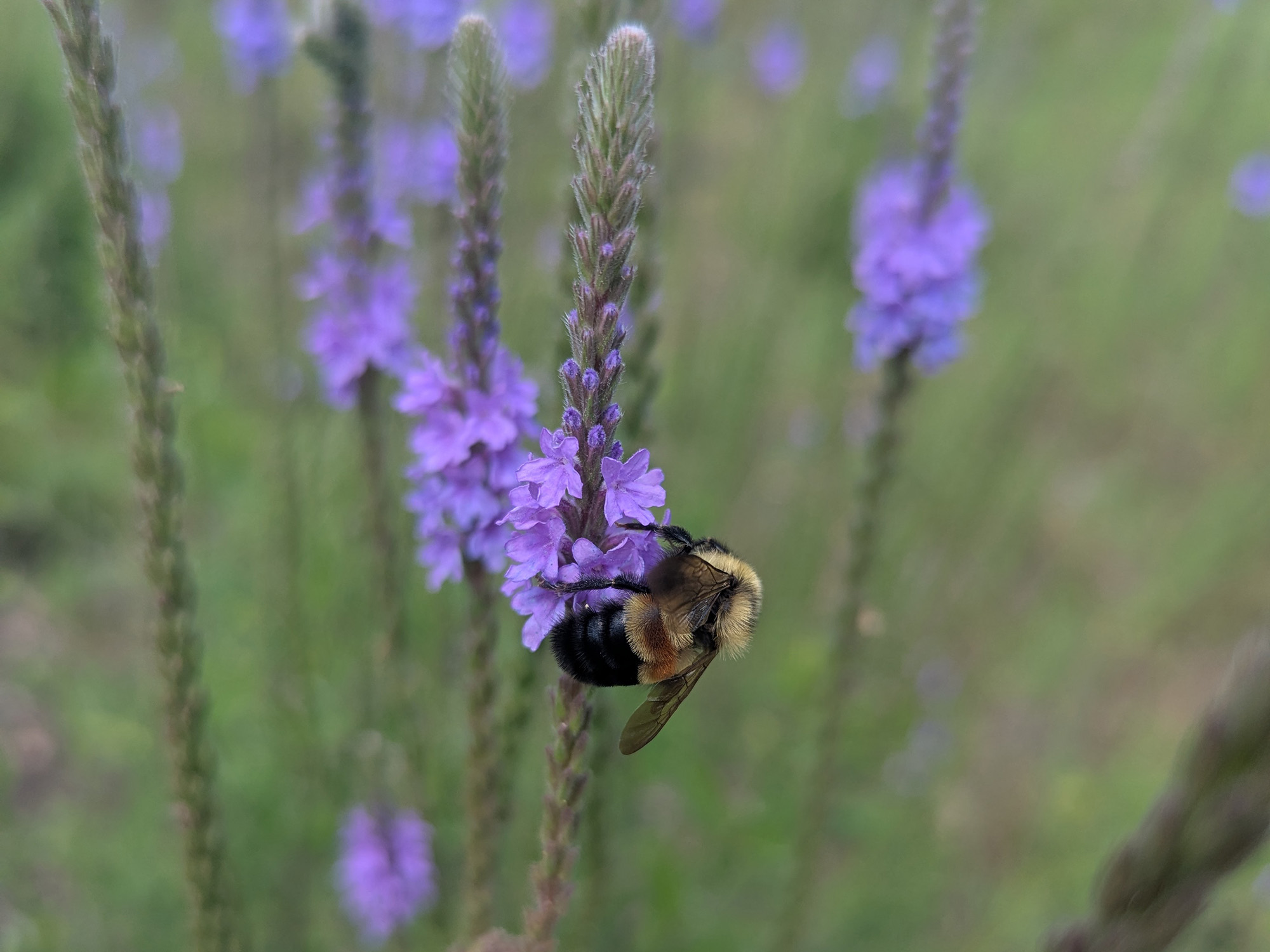
FMR's bumble bee research will help us and others improve habitat for pollinators like this federally endangered rusty-patched bumble bee we found at an FMR project site.
How can we improve habitat for bumble bees? That's the question our latest research project sought to answer.
Because habitat loss and fragmentation are among the main drivers of the alarming decline in pollinator populations, Friends of the Mississippi River has made supporting pollinators one of our Land Conservation team's strategic goals.
We designed a multi-year research project to aid this effort, funded by the Environment and Natural Resources Trust Fund. Over the 2024 and 2025 field seasons, we conducted 144 bumble bee surveys across FMR's network of restoration sites to better understand what makes a high-quality restoration. During this fieldwork, we observed over 1,200 bumble bees of 14 species, including eight federally endangered rusty-patched bumble bees.
Now we're sharing our full results to help FMR and other natural resource professionals refine our approaches so that bumble bees and other wildlife have the homes and resources they need to flourish.
We observed three times as many bees in restored prairies compared to remnant prairies.
Since relationships between specific plants and pollinators often evolve over millennia, you might imagine that a remnant prairie — a prairie that has existed since before European colonization — would sustain more pollinators.
Our research revealed that we found three times as many bumble bees at restored prairie sites as at remnant prairie sites. Additionally, we observed a greater diversity of bumble bee species in restored sites than in remnant ones.
Digging into the data, we found that this pattern was associated with several factors, including a site's overall habitat score and the number of blooming plant species during bee surveys.
The takeaway for us here is that our process for restoring habitat for bumble bees is working! That's encouraging, given that so much of our native prairies have been lost.
These findings don't diminish the importance of conserving remnant prairie, particularly for plant species that are difficult to establish in restoration areas or to obtain from seed producers, such as pasque flower, puccoon, bird's-foot violet and porcupine grass. Higher proportions of bees that specialize on resources from specific flowers have been found in remnant prairies, too, likely due to the absence of their required host plants in restorations.
Bumble bees love bee balm.
The most frequently visited flower species in our study was bee balm, followed by Canada goldenrod, field thistle and anise hyssop. Over 70% of all bumble bee visits to these species occurred in restorations.
Bee balm establishes quickly and can spread aggressively, making it an excellent native plant species to include in restorations — and the bumble bees love it! But it's important to plant more than just bee balm. Less-abundant flowers matter too, as does flower diversity.
Despite similar numbers of flowering plant species and foraging resources in both restored and remnant prairies, bumble bees primarily foraged on different flower species in each context. Bumble bees visited 13 distinct flower species in remnant prairies, 30 distinct flower species in restored prairies, and only 11 flower species across both prairie types.
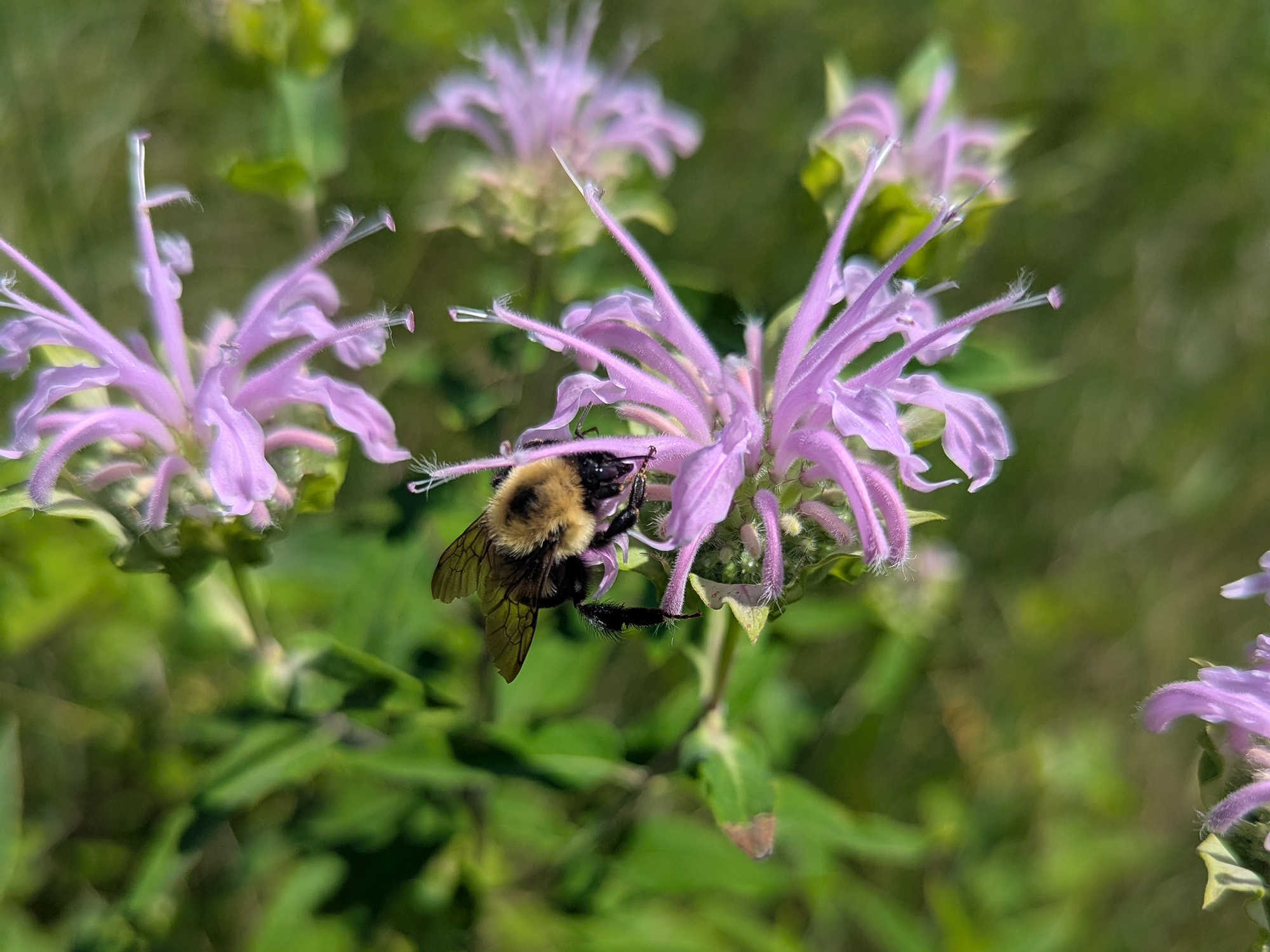
We observed bumble bees visiting bee balm more than any other flower.
Higher diversity of native plant species in seed mixes paid off.
In areas seeded with more native plant species, we found more flowering plant species in bloom during our surveys and, in turn, higher rates of bumble bee foraging activity. We found more bees foraging in units seeded with 70 native species than in units seeded with 50 or 30 species.
That result might seem unsurprising, but it's helpful to have data showing the efficacy of seed mixes. Knowing that seeding more plant species really does increase habitat quality can give us confidence to prioritize that diversity as we craft seed mixes and budgets for restoration.
Bumble bees foraged on 54 flower species over the course of our study, highlighting again the importance of floral diversity for quality pollinator habitat. And while several flower species attracted the most bumble bees, some of the rarer bumble bee species were primarily visiting less abundant flowers. For example, we found rusty-patched bumble bees primarily on hoary vervain. Figwort, an unassuming plant with nearly colorless flowers, attracted multiple bumble bee species.
How we seeded plots didn't increase or decrease bee findings.
We primarily use two methods to seed prairie restoration sites: broadcast seeding and drill seeding.
Broadcast seeding scatters seeds across the surface of a site by hand or with light equipment. When done on a large scale, it can be more time-consuming but also mimics the way seeds are naturally deposited on the soil surface.
Drill seeding, on the other hand, uses equipment to plant seeds at a set depth and distribution, which can result in higher germination rates but also has a greater impact on soils.
We found no significant difference in the number of bumble bees or the number of bumble bee species between units where we broadcast seeds and units where we drill-seeded.
This finding can help conservation practitioners budget effectively, since each seeding method has its own costs and benefits, as well as logistical considerations. At a large scale, drill seeding typically costs less than broadcast seeding. The use of drill seeding at suitable sites could free up funds to invest in higher-diversity seed mixes, providing a net benefit to bumble bees.
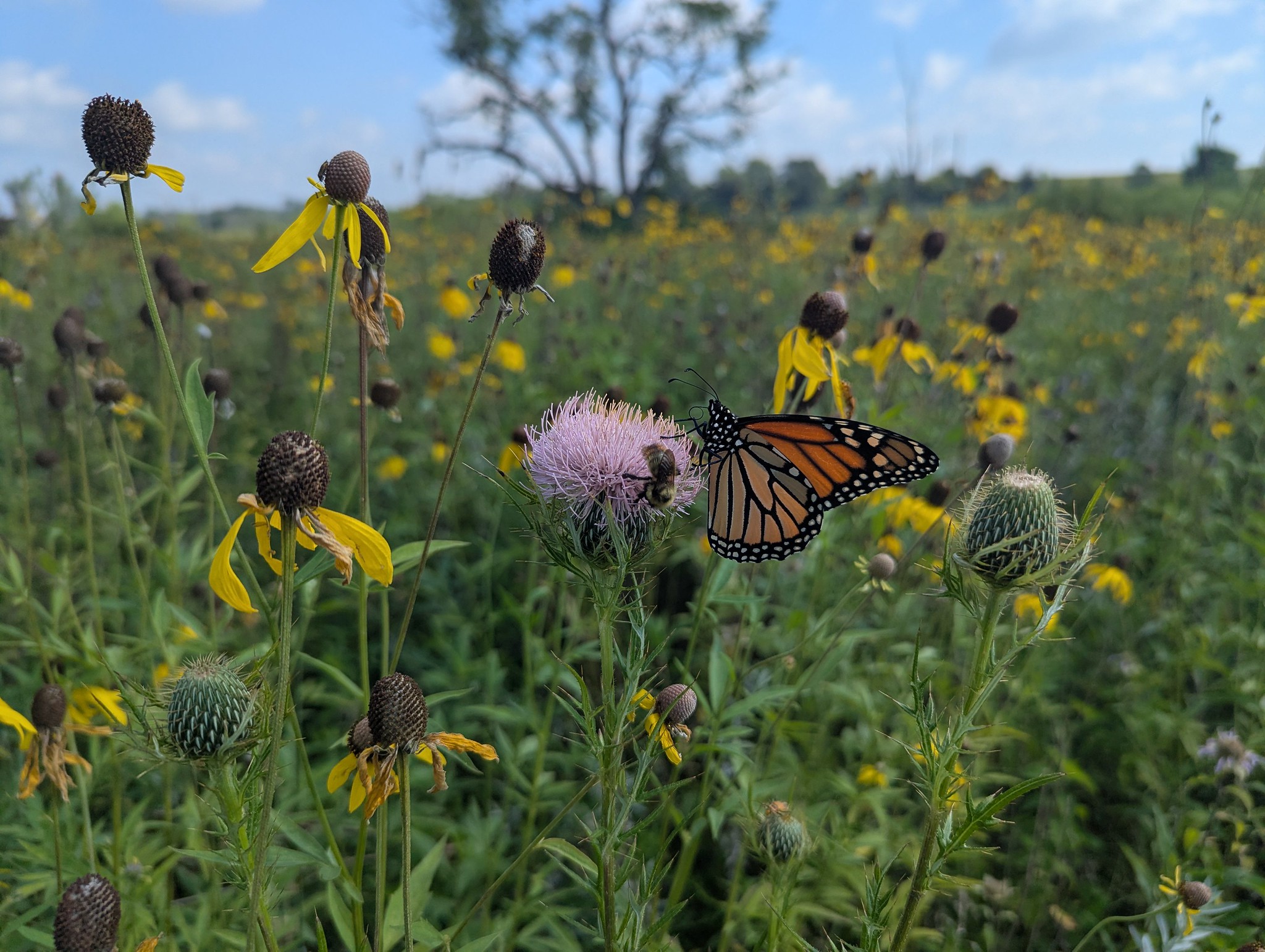
We observed many other pollinators during our prairie surveys, including quite a few monarch butterflies.
Good for the bees, good for the river
Friends of the Mississippi River works at more than 45 restoration project sites near the metro Mississippi River. As a river-focused organization, we care about restoring habitat to improve water quality and support the wildlife and systems the river sustains.
In this work, we practice adaptive management, which requires monitoring and understanding the effects of past management decisions in order to plan for the future. Our pollinator research not only enables us to share valuable information with the restoration and scientific communities about what bumble bees need, but also to evaluate our restoration practices and apply the findings to our own work.
We have shared the results of this study through conference presentations at the 2025 Entomological Society of America annual meeting and BeeCon. In the coming months, we will share reports with partners and the practitioner community.
Get involved
Want to help bumble bees and other pollinators too? Check out our tips for supporting pollinators and get to know Minnesota's native bees.
Thanks to our funders and partners
Funding for this project was provided by the Minnesota Environment and Natural Resources Trust Fund as recommended by the Legislative-Citizen Commission on Minnesota Resources (LCCMR).
Thank you to our land-owner partners: the Minnesota Department of Natural Resources Scientific and Natural Area Program, 3M Cottage Grove, Flint Hills Resources and the City of Elk River. Thank you also to interns who assisted with data collection and management: Nick Levine, Ethan Phan, Lauren Schmelzer, Rashi DaSilva, Aaryan Awasthi and Tori Duckworth. We are grateful to professional colleagues who consulted on study design and methodology.