
New study highlights economic benefits of dam removal
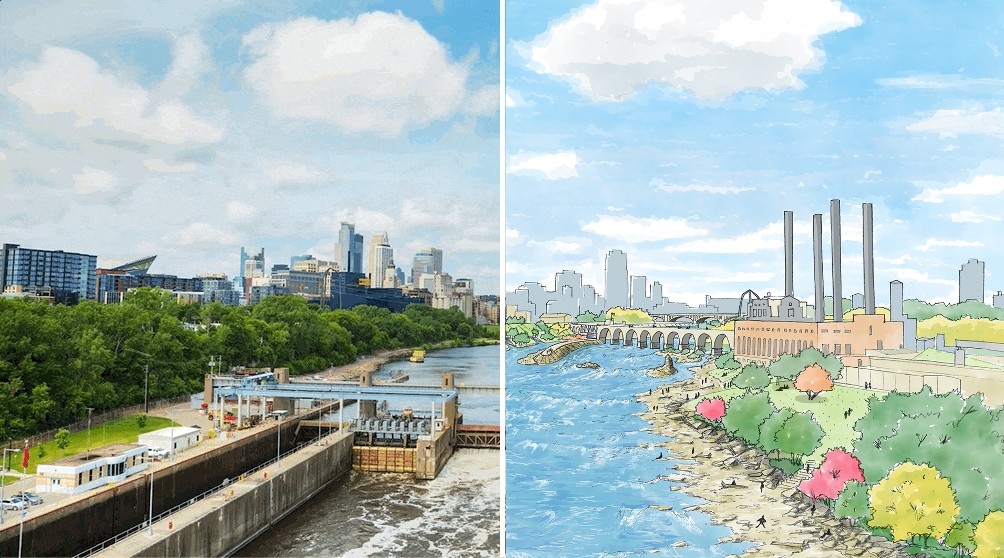
Above, we see Lower St. Anthony Falls Lock and Dam near downtown Minneapolis. The left half is a photo by Andrey Kr. The right is a reimagined rendering featuring whitewater rapids by LVBrown Studio courtesy of National Park Conservation Association.
As we consider whether dam removal makes sense for the Mississippi River in the Twin Cities, it can be hard to envision what a partially undammed river would look like — and how that might change how we relate to it.
Our partners at the National Parks Conservation Association recently answered some of these questions in a new report. “Reimagining the River” provides a first look at how removing two locks and dams — Lower St. Anthony Falls and Lock and Dam 1 (often called the Ford dam) — could impact the Twin Cities’ recreation and tourism economies.
Before we get into key findings, a quick note: FMR and the NPCA do not have a formal position on the removal of these two locks and dams at this time. With our River Guardians, we advocate for robust community engagement and thorough studies, such as this, as the Twin Cities considers this important long-term decision.
Dam removal would open new recreation
Today, most recreation in the river gorge between the Lower St. Anthony Falls lock and dam in downtown Minneapolis and the confluence with the Minnesota River in St. Paul happens on shore: walking, biking, hiking, birdwatching and shore fishing are all popular.
Dam removal in this stretch would likely draw more people to the water as the river would become more accessible and varied.
Just below St. Anthony Falls, or Owámniyomni, whitewater rapids could draw thrill-seekers. The rapids would also provide vital spawning grounds for fish, including many species not present today.
Downstream, the river would gradually mellow. New islands, shorelines and braided river channels would be ideal for paddling, tubing, wade-in fishing and exploring.
These activities could draw new businesses to the river. Outdoor guides, gear rental and food and beverage vendors would be needed. Such services could be provided without big new buildings or development footprints, and could provide hundreds of jobs.
However, an undammed river would change some existing recreational uses. A shallower, faster river would no longer be suitable for rowing. The report estimates that 400 people each year row in the river gorge through the largest rowing programs, the Minneapolis Rowing Club and the University of Minnesota, and that roughly 600-700 people participate in an annual regatta. Large motorized boats, whether that be commercial operators or private boats, would have to stay further downstream.
Peer cities reap river restoration returns
The report discusses several peer cities that removed dams and/or made significant improvements in river quality, access and recreation. The James River in Richmond, Virginia draws 1.9 million visitors to its downtown river gorge each year for paddlesports, tubing and rafting.
Pittsburgh, Pennsylvania invested in closing river access gaps and creating routes where users can combine walking, biking, and paddling. Trail usership more than doubled and is now tied to $22 million in annual local spending.
These communities, along with others included in the report, have each seen $11-34 million in visitor spending each year along their rivers.
Much more to study and consider
This new study is exciting, but can’t answer all of our questions about whether dam removal is right for the Mississippi River. That’s why FMR is leading a study to examine the ecological, infrastructure and engineering aspects of dam removal. That study will be complete in 2028, and is funded by the Minnesota Environment and Natural Resources Trust Fund as recommended by the Legislative-Citizen Commission on Minnesota Resources, as well as by the Mississippi Watershed Management Organization.
Removing the dams and restoring the Mississippi River could be expensive. But it's important to take a long-term view about the costs of keeping the dams in place versus the benefits we could reap from restoration. This new report offers an intriguing vision for what our Mississippi River might be someday.
Learn more and get involved
The larger process of considering the fate of our metro locks and dams will unfold over many years, and FMR and our partners will be involved every step of the way.
We'll share updates in Mississippi Messages, and host a variety of workshops, tours and events. The best way to keep up with the latest news and hear about opportunities to get involved is to sign up as an FMR River Guardian.
Become a River Guardian
Sign up and we'll email you when important river issues arise. We make it quick and easy to contact decision-makers. River Guardians are also invited to special social hours and other events about legislative and metro river corridor issues.