
New FMR study will help answer crucial questions about potential dam removal
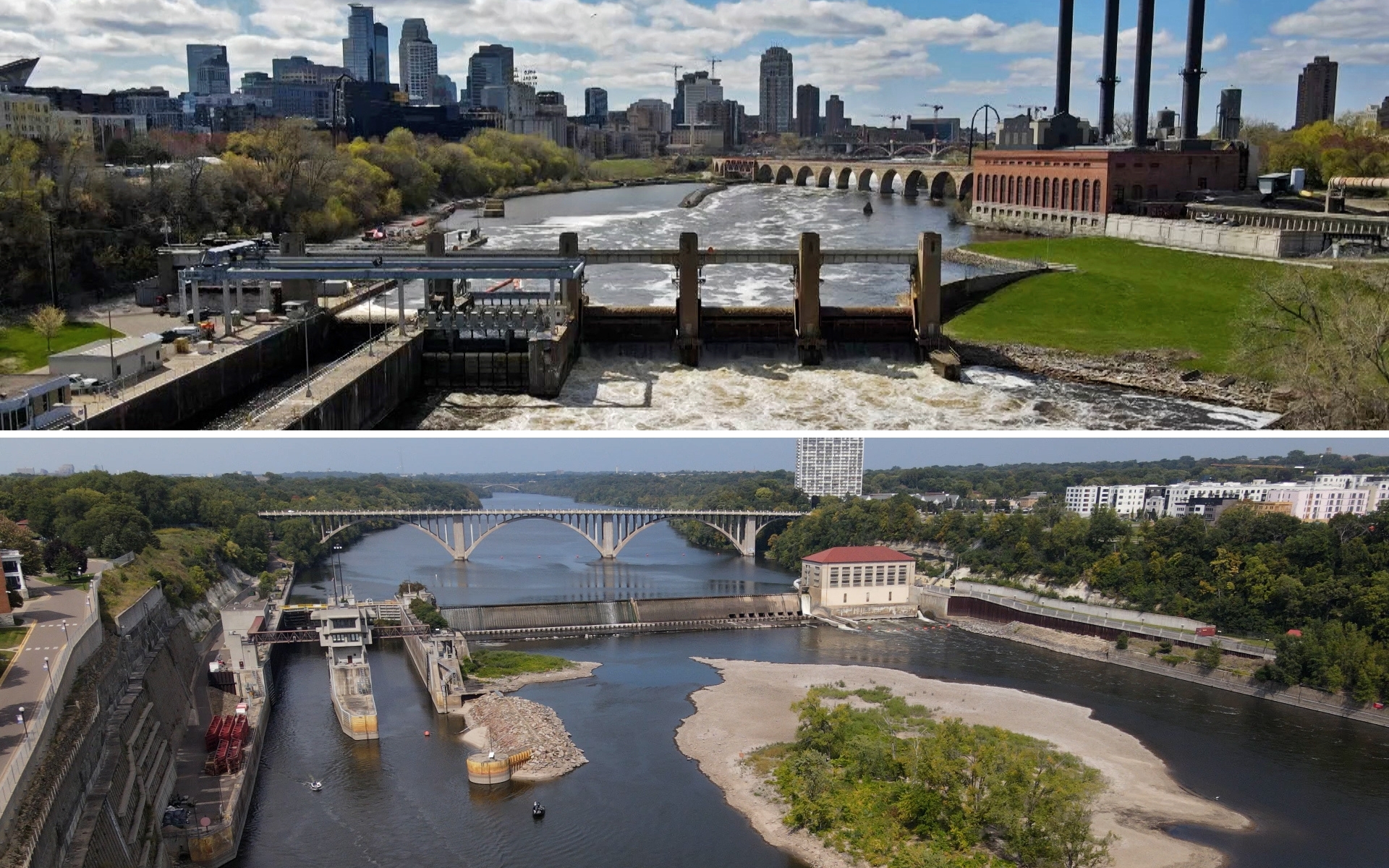
Lower St. Anthony Falls Lock and Dam (top) and Lock and Dam 1 (bottom) are both functionally obsolete, aging structures. We’re working on a major study to help us understand if removal makes sense for these two metro locks and dams. (Photos by Mike Durenberger for FMR)
Should two locks and dams in the heart of the Twin Cities be removed?
Lower St. Anthony Falls Lock and Dam and Lock and Dam 1 (the Ford dam) are both aging and functionally obsolete. (Learn more about the history of these locks and dams.)
Removing these structures would restore rare habitat, improve water quality and enhance river recreation.
But we don’t yet have enough information to determine whether removal is the right choice. FMR's major new study will help us find out.
Unanswered questions
Next year, the U.S. Army Corps of Engineers will release a "disposition study" outlining its recommendations for these two structures (which it owns).
This will be a high-level review focused primarily on what makes the most sense for the Corps’ mission and budget. The Corps has said its study will likely recommend transferring the dams to a willing owner.
The Corps' disposition study won’t be comprehensive enough to explore or answer crucial questions about dam removal, like: Where would new islands, rapids and shorelines arise in an undammed river? How might rare species like paddlefish and some mussels benefit? How much sediment is built up behind the existing structures, and can it be safely released downstream?
FMR is designing and securing funding for a feasibility study to fill this critical information gap.
We’re excited to announce that in spring 2026, the Minnesota Legislature approved a $923,000 Environment and Natural Resources Trust Fund grant to FMR for this project, thanks in part to advocacy from River Guardians. The Mississippi Watershed Management Organization has contributed additional funds.
Congress will make the final decision about what to do with these federally owned dams. Our members of Congress will be listening to feedback from Tribal and local governments and community members. FMR's study will provide information for everyone to help guide these decisions.
Filling the information gap
Ultimately, the decision about dam removal comes down to two questions: Can it be safely done? And will the benefits outweigh the costs?
By examining the habitat restoration opportunities, water quality improvements, endangered species benefits, sediment transport, infrastructure impacts and recreational changes that dam removal could bring, this project will support scientifically sound decision-making to improve the health of the Mississippi River in the Twin Cities and downstream.
Here are some of the crucial questions this study will address:
Changes to the river channel
How would water levels change in an undammed river? Would dam removal affect the frequency, intensity or duration of flood events in the gorge or downstream?
What would the river look like after dam removal? Where would new islands, floodplains and shorelines be?
Ecological changes
What kind of habitats would be created in and along a restored river, and what species would benefit? Would dam removal expand the spread of any invasive species?
What changes would we see in water quality?
Sediment composition and transport
For over a century, Lock and Dam 1 has kept sediment from following its natural course down the river, and it’s backed up behind the dam.
Now we need to know: How can the excess sediment be used to reconstruct the former shoreline and islands?
If sediment were to be released downstream, where would it move to? Would that cause any ecological issues downstream or even in Lake Pepin?
We believe some of the sediment is contaminated with hazardous substances. How much will it cost to properly clean up those areas?
Infrastructure impacts
How will urban infrastructure in and along the river — such as bridges, stormwater outfalls and utilities — be affected by dam removal and lower river levels?
How would lower water levels impact surrounding properties like the University of Minnesota and Minneapolis and St. Paul parks?
What adaptations would be needed for these structures and properties, and what would they cost?
Recreational changes
Later this month, the National Parks Conservation Association (one of FMR’s partners) is publishing a report highlighting the potential economic benefits of tourism and recreation from an undammed, restored Mississippi River in Minneapolis-St. Paul. (We’ll share the report once available in our enewsletter.)
Our forthcoming study may provide more details on how changes in the river’s shoreline, flow, fish populations, etc., would guide where recreational amenities can be added or enhanced.
Dam removal options
The study will include multiple prospective scenarios for removing the locks and dams, including the possibility of removing just one dam, leaving elements of the structures in place, etc. It will also discuss the costs, benefits and drawbacks of different approaches.
All of these findings will be available for the public and policymakers to review. The final report will include a condensed, easy-to-read version along with renderings to illustrate the possibilities of an undammed river.
How the study was designed
We aren’t designing this study alone. This project came out of years of conversations with community members, elected officials and technical experts. FMR and our partners have given tours and presentations to over 1,300 people. We’ve met with dozens of researchers, engineers and ecologists to figure out what we need to learn and what data sources already exist.
The study itself will be carried out by an independent engineering firm chosen through a competitive bidding process later this year.
FMR’s partners in this long process include the National Parks Conservation Association, American Rivers, Dr. Roopali Phadke at Macalester College and Dr. Bruce Braun and the St. Anthony Falls Lab at the University of Minnesota.
What’s next?
The study findings will be released to the public in 2028, and FMR and our partners will provide many opportunities to learn about its recommendations and weigh the pros and cons together as we advocate for the best future for the river.
Community members and local, state, federal and Tribal nation elected officials all have a role to play in making these decisions. But given the significance of the Mississippi River gorge to Dakota people, we believe that Dakota Tribes should lead its future.
In collaboration with Owámniyomni Okhódayapi, FMR has held meetings and site visits with Dakota Tribes’ elected leaders to learn from them about what, if any, role they would like to have in deciding the future of these locks and dams, and what information this supplemental study must include to support their decision-making. We look forward to continuing this work together.
Become a River Guardian
Sign up and we'll email you when important river issues arise. We make it quick and easy to contact decision-makers. River Guardians are also invited to special social hours and other events about legislative and metro river corridor issues.