
St. Anthony Falls cutoff wall: No immediate threat, advocacy still needed
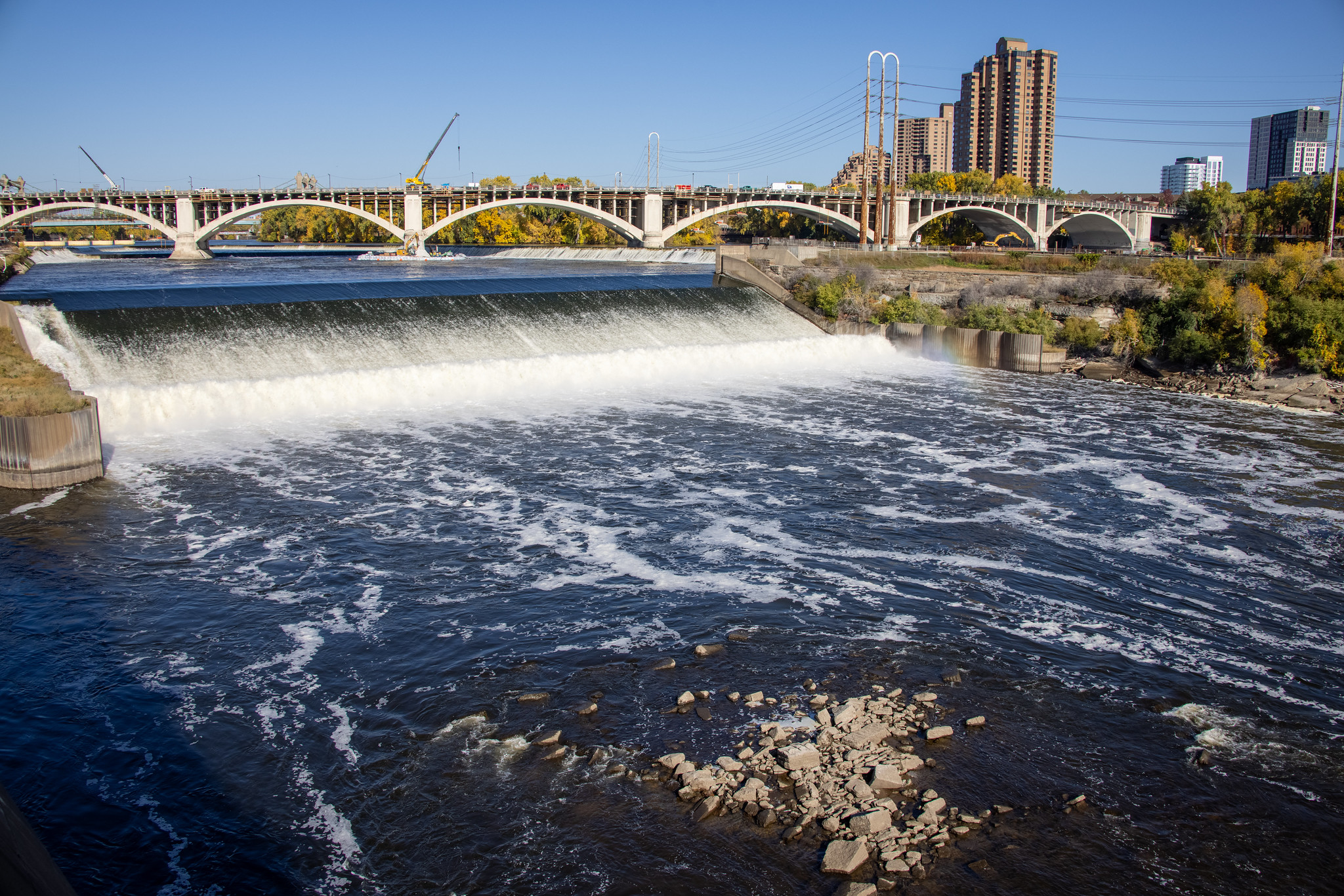
A three-story concrete cutoff wall beneath the riverbed helps support St. Anthony Falls in downtown Minneapolis (above). A new study shows no immediate risks, but reinforces the need for monitoring. (Photo by Tom Reiter)
Many readers may recall FMR’s concerns about a potential hidden hazard in the downtown Minneapolis riverfront: a little-known, aging concrete wall (known as the cutoff wall) built underneath the riverbed just above St. Anthony Falls.
Built by the U.S. Army Corps of Engineers in the 1870s, the wall helps stabilize the riverbed around the falls and maintain the water levels needed for our drinking water supply. But who owns the wall, and its condition, were unknown.
Thanks to years of advocacy by FMR and River Guardians, the Minnesota Legislature funded a $1 million study of the cutoff wall.
The University of Minnesota’s St. Anthony Falls Laboratory and Hennepin County recently completed this investigation into the cutoff wall’s history, condition, and what might happen if it failed.
Study says: OK for now, but risks remain
We highly recommend reading this Minnesota Star Tribune piece by Susan Du on the completed study if you can, but the most important takeaway (and good news) is that researchers “did not find any evidence of impending or immediate failure of the St. Anthony Falls region related to the cutoff wall or other subsurface infrastructure.”
Thanks to this study, we also know a lot more about the condition of the wall and surrounding tunnels, how a structural failure could play out, what infrastructure in the area would be at risk, and how to prepare for those situations.
In the cutoff wall's current state, a structure failure is highly unlikely. But we need to build on what researchers have documented about the wall’s condition with continuous monitoring to alert us if conditions change. The cutoff wall, which is 40 feet tall and over 1,800 feet long, needs to be monitored in the same way we routinely inspect bridges, locks, dams and other structurally significant infrastructure.
We need to determine who owns it
This study was never intended to resolve ownership of the cutoff wall. It’s more critical than ever to determine this, so the responsible party can begin inspecting and monitoring to safeguard all the structures surrounding the falls.
Researchers also emphasized that ownership of the historic tunnels around the wall — including the Eastman and West Branch tunnels, and others — is also unclear. Those tunnels need the same level of attention as the wall itself. (Dams, bridges and other structures around the falls all have assigned owners and are frequently inspected.)
FMR and our partners are sharing the study findings and advocating to elected leaders to act to resolve this ownership issue and begin monitoring and inspections as quickly as possible.
When there’s a moment for the public to help push for a solution, we’ll let our River Guardians know. Join our River Guardians to hear from us about advocating for the river.
To see the full progression of this issue over time, see our full history of updates.
Become a River Guardian
Sign up and we'll email you when important river issues arise. We make it quick and easy to contact decision-makers. River Guardians are also invited to special social hours and other events about legislative and metro river corridor issues.