
How FMR helped establish MN's first environmental guardrails on SAF
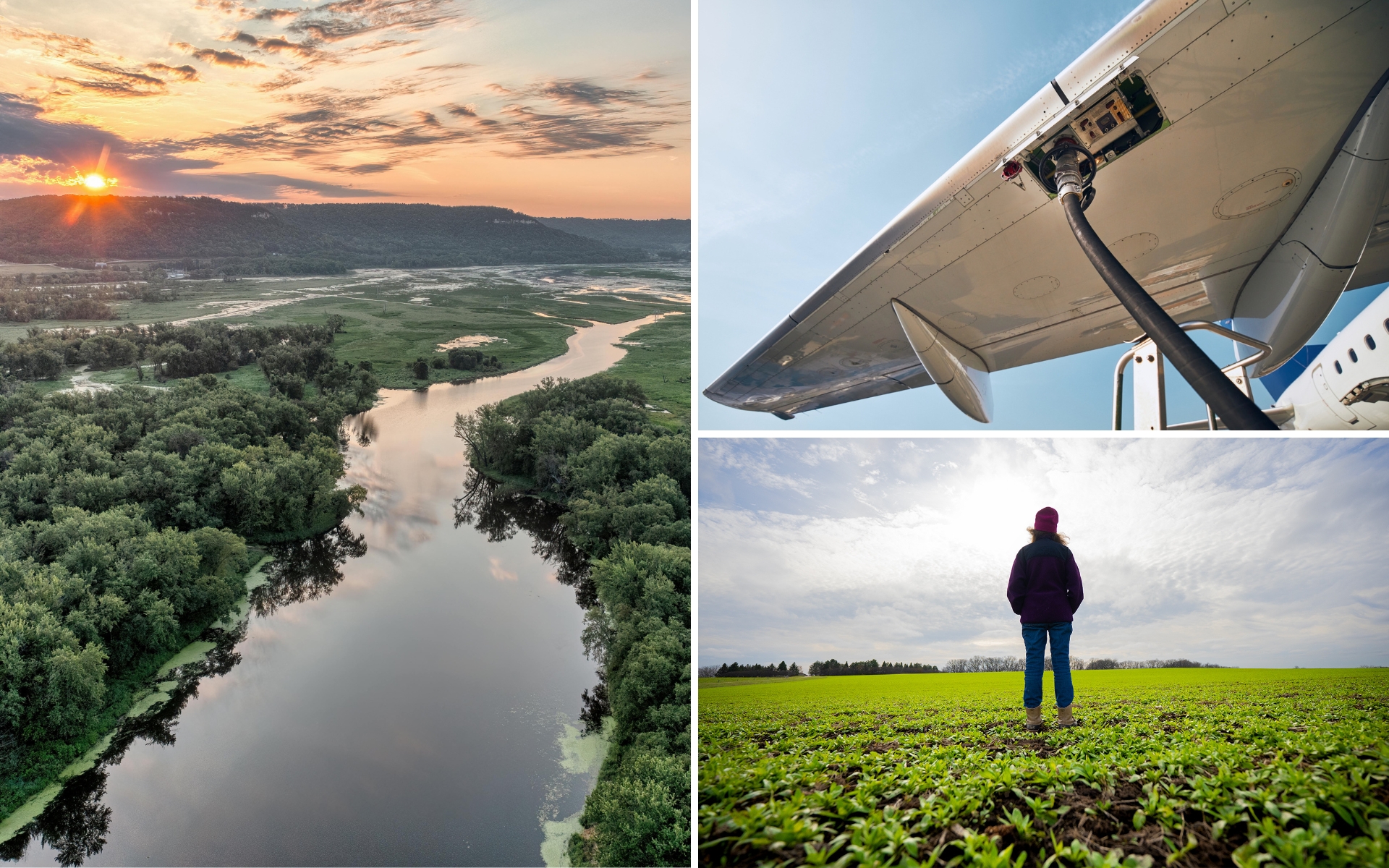
The guardrails set a bar that fuel producers must clear to be considered "sustainable" — with real incentive for the most sustainable feedstocks, like winter camelina. (Photos, clockwise from left: Canva, Canva, Dodd Demas for FMR)
Minnesota now has the most stringent environmental requirements in the country for sustainable jet fuel. As this emerging industry ramps up, companies that make or blend sustainable aviation fuel (aka "SAF") in Minnesota will now need to account for impacts to water quality, habitat and biodiversity in order to qualify for the state’s SAF tax credit.
This is thanks to a bill passed during the state’s 2026 legislative session, which made Minnesota the first state in the country with such environmental guardrails tied to SAF production.
These new guardrails open the door for a fundamental shift in Minnesota’s agriculture system, where the usual summer annuals and new clean-water crops work in tandem to cover the soil — improving water quality, habitat, agricultural resilience and farm prosperity.
A major reason for this shift is the stronger rewards for SAF made with winter-hardy oilseeds such as winter camelina, currently the most sustainable feedstock available.
Ask FMR: What is a feedstock?
"Feedstock is just a fancy term for what a fuel is made out of. Crude oil is a feedstock. So is corn, which we use to make ethanol. We’re working to make sure sustainable aviation fuel decision-makers commit to feedstocks that are actually sustainable for water and habitat, like winter-hardy oilseeds."
Developed by our partners at the U of M's Forever Green Initiative, these oilseeds grow and survive through fall, winter and spring, covering what would otherwise be millions of acres of unprotected soil. By keeping soil covered at a time it would typically be bare, winter-hardy oilseeds prevent snowmelt and rainfall from washing topsoil, fertilizer and pesticides into our waters.
These new guardrails are a significant win for the health of the Mississippi River and a step toward a SAF industry that accounts for many definitions of sustainability, not just carbon emissions.
How we got here
SAF really wasn’t on the radar screen in Minnesota until 2023, when a relatively modest, short-term state SAF tax credit was included in that year’s transportation budget.
FMR soon realized that SAF’s impact on the Mississippi River watershed will be significant. Whether that impact is positive or negative depends on the policy decisions state leaders make.
One of our earliest goals was to help decision-makers understand the connection between SAF, agriculture and water quality, and to provide some science-backed guidance that would help shape future SAF policy.
That’s why we teamed up with our friends at Fresh Energy and The Nature Conservancy to propose guiding principles for the SAF industry in Minnesota. Those guiding principles, released in July 2024, demonstrate how to reduce aviation industry emissions while advancing progress toward complementary environmental and social goals.
That laid the groundwork for what needed to come next: revisions to state statute that would guide SAF industry toward these sustainability principles.
The guardrails: Building a winning coalition
A first attempt to pass a set of environmental guardrails for SAF didn't go as hoped. First introduced during the 2025 legislative sessions, right on the heels of our guiding principles, the language disappeared from the final bill package (much to our disappointment).
In order to get guardrails passed in 2026, we realized we needed to pull together not just the DFL and GOP, but also other stakeholders that don’t typically advocate alongside each other.
So over the next year, FMR set about making the case to environmental NGOs, state legislators, industry groups and state agencies that prioritizing sustainability in SAF is not only good for the climate, it’s necessary for business. A SAF industry that improves water quality by prioritizing winter-hardy camelina as a fuel source; that protects forests and prairies from conversion to agricultural land; and that facilitates an economic boost for farmers, is one that will legitimately earn people’s trust.
With that trust comes the public and private investments required to make SAF a success.
FMR ultimately worked alongside the Forever Green Initiative, Minnesota Farm Bureau, Minnesota Environmental Partnership, Minnesota Pipe Trades Association, Fresh Energy, the Minnesota Department of Agriculture, the Minnesota Farmers Union, Minnesota Forest Industries, the Minnesota State Building & Construction Trades Council, and the Minnesota SAF Hub to advance a shared strategy that would likely not have succeeded otherwise.
That turned out to be the right approach.
Legislation establishing new environmental guardrails for the existing Minnesota SAF tax credit was one of the few pieces of bipartisan legislation to pass in 2026. FMR’s River Guardians also played an important role, sending 407 messages of support to legislators.
Lawmakers took notice of this group effort.
DFL Sen. Scott Dibble dubbed the package of environmental guardrails the "feel-good bill of the year."
Republican Rep. Bobbie Harder described it as a "win-win-win," while her colleague Republican Rep. Greg Davids remarked: "If you ever would have told me that we’d have a list like this [supporting the same legislation] … I would have said, 'can’t be done'. But it has been done."
How the guardrails make SAF more sustainable
The environmental guardrails legislation passed in 2026 adds five safeguards to an existing tax credit to ensure that any SAF made or blended in Minnesota is produced with water quality, habitat and other sustainability principles in mind. It rewards the lowest-carbon fuels, protects natural lands both in Minnesota and abroad, prevents any connection to enhanced oil recovery and clears a path for future sustainable SAF sources. It also expands the tax credit and extends it further into the future.
These new guardrails give Minnesota the most stringent SAF sustainability measures in the country, a critical step to ensuring a new SAF industry in the state helps, rather than harms, the river.
It’s also a model we hope other states look to. As the SAF industry begins to take flight across the nation, we would love to see Minnesota's environmental guardrails — and the bipartisan, multi-sector approach to the issue — replicated by others.
We’ve shared this message with national audiences, including at the 2026 North American SAF Conference, and we’ll continue to advocate for policies that keep SAF as sustainable as the name suggests.
We also know that policy alone is not enough. We need a plan for long-term success.
Winter camelina and the tipping point
Critical to SAF actually being sustainable is the industry’s embrace of winter camelina, the winter-hardy oilseed being developed by Forever Green. Not only can camelina be turned into safe, effective fuel, it also grows over the winter and helps protect water quality.
In order to meet the demand for SAF, we’ll need to grow a lot of camelina - and we need a plan for making that happen. A soon-to-be released report will detail how our region can get to the first 1 million acres of this crop, an important milestone that tips winter camelina from a newcomer crop to one with a legitimate, undeniable market.
The report’s main takeaway is that, while there are barriers, reaching 1 million acres of winter camelina is doable. Achieving this milestone will require targeted policy choices, investments and coordination over the coming decade, but it is within reach.
We’re working to take these recommendations and make them a reality, working alongside many of the same people who supported the guardrails in order to scale this sustainable crop. It’s essential to making Minnesota SAF as low-carbon, river-friendly and sustainable as possible.